

The automotive industry demands the highest level of quality, safety, and consistency. Every manufacturer and supplier must ensure that products meet customer expectations while complying with global quality standards. This is where an IATF 16949 Audit plays a crucial role.
An IATF 16949 audit is not just about passing a certification assessment; it is about evaluating your Quality Management System (QMS), identifying areas for improvement, reducing risks, and building a culture of continuous improvement. Whether you are preparing for certification or maintaining compliance, understanding the audit process can help your organization achieve long-term success.
At GQA Consultants, we help automotive manufacturers and suppliers implement, maintain, and improve their Quality Management Systems through expert consulting, training, documentation, and audit support.
What is an IATF 16949 Audit?
An IATF 16949 Audit is a systematic evaluation of an organization's Automotive Quality Management System based on the requirements of the IATF 16949 Standard. The objective is to verify that the organization's processes meet customer-specific requirements, statutory requirements, and the requirements defined by the International Automotive Task Force (IATF).
The audit examines every stage of the manufacturing process, including:
- Quality Management System implementation
- Production planning
- Supplier management
- Risk assessment
- Product quality
- Customer satisfaction
- Continuous improvement
- Corrective and preventive actions
A successful audit demonstrates that your organization consistently delivers high-quality products while continually improving operational performance.
Types of IATF 16949 Audits
Understanding the different types of audits helps organizations prepare effectively and maintain compliance with the IATF 16949 Standard. A successful audit demonstrates that your organization consistently delivers high-quality products while continually improving operational performance.

Why is the IATF 16949 Standard Important?
The IATF 16949 Standard is recognized globally by automotive manufacturers and suppliers. It is built on ISO 9001 and includes additional automotive-specific requirements focused on defect prevention, waste reduction, and process improvement.
Organizations certified to IATF 16949 benefit from:
- Improved product quality
- Increased customer confidence
- Better process control
- Reduced production defects
- Stronger supplier performance
- Higher operational efficiency
- Increased opportunities to work with OEMs and Tier-1 suppliers
For many automotive companies, IATF 16949 certification is a mandatory requirement for entering global supply chains.
Understanding IATF 16949 Gap Analysis
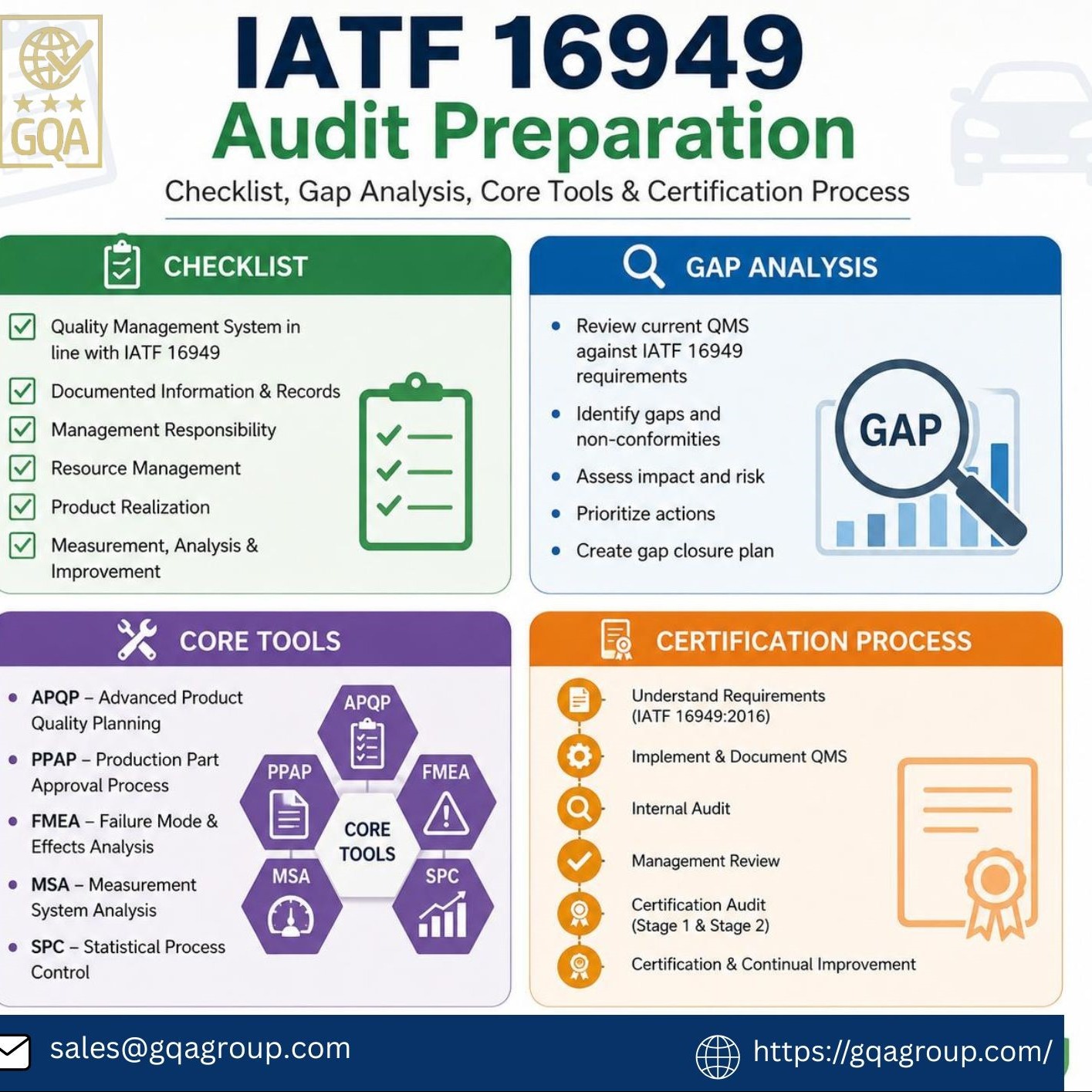
Before certification or surveillance audits, companies should perform an IATF 16949 Gap Analysis.
Gap analysis compares your current management system with the requirements of the standard to identify missing processes, documentation, or implementation gaps.
Typical areas reviewed include:
- Process documentation
- Risk-based thinking
- Internal audit process
- Management review
- Supplier evaluation
- Production controls
- Customer-specific requirements
- Performance monitoring
Conducting a gap analysis early helps organizations save time, reduce non-conformities, and prepare effectively for certification.
Why Internal Audits Matter
Internal audits are one of the most powerful tools for maintaining compliance.
An internal audit helps organizations:
- Identify weaknesses before certification audits
- Detect process deviations
- Improve process efficiency
- Reduce quality risks
- Ensure compliance with customer requirements
- Promote continual improvement
Instead of viewing audits as inspections, successful companies treat them as opportunities to strengthen their systems.
Importance of IATF 16949 Internal Auditor Training
Effective audits require skilled auditors. This is why IATF 16949 Internal Auditor Training is essential for organizations implementing the standard.
Training enables employees to:
- Understand audit principles
- Interpret IATF 16949 requirements
- Conduct process-based audits
- Identify non-conformities
- Prepare audit reports
- Recommend corrective actions
- Improve organizational performance
A well-trained internal audit team creates confidence before external certification audits and supports continuous improvement throughout the organization.
Automotive Core Tools – The Foundation of Quality
One of the major requirements of IATF 16949 is the effective implementation of Automotive Core Tools.
These tools include:
- APQP (Advanced Product Quality Planning)
- PPAP (Production Part Approval Process)
- FMEA (Failure Mode and Effects Analysis)
- SPC (Statistical Process Control)
- MSA (Measurement System Analysis)
Proper implementation of these Core Tools helps organizations reduce defects, improve process capability, and satisfy customer requirements.
During an IATF 16949 audit, auditors verify that these tools are effectively implemented rather than simply documented.
IATF 16949 Checklist for Audit Preparation
Preparing with an IATF 16949 Checklist helps organizations conduct a thorough review before the certification audit.
A basic checklist includes:
- Quality Policy and Objectives
- Process Mapping
- Risk Assessment
- Customer-Specific Requirements
- Document Control
- Internal Audit Records
- Management Review Minutes
- Corrective Action Reports
- Calibration Records
- Training Records
- Supplier Performance Evaluation
- Process Performance Monitoring
- Production Controls
- Traceability System
- Core Tools Implementation
Regularly reviewing this checklist minimizes audit findings and improves readiness.
Why IATF 16949 is Essential for Auto Component Manufacturers
Today, IATF 16949 for auto component manufacturers is more than just a certification it is a competitive advantage.
Automotive OEMs expect suppliers to maintain consistent quality, effective risk management, and robust production processes.
Certification helps manufacturers:
- Win new business opportunities
- Improve supplier credibility
- Reduce warranty claims
- Enhance customer satisfaction
- Improve production efficiency
- Build stronger relationships with global automotive companies
For auto component manufacturers aiming to supply OEMs or Tier-1 companies, IATF 16949 certification has become a business necessity.
Choosing the Right IATF 16949 Training Provider
Selecting an experienced IATF 16949 training provider is one of the most important decisions during implementation.
A reliable training provider should offer:
- Industry-experienced trainers
- Practical case studies
- Hands-on audit exercises
- Core Tools training
- Documentation support
- Gap analysis assistance
- Internal auditor training
- Post-training implementation guidance
Practical training ensures that employees understand not only the requirements but also how to apply them in real manufacturing environments.
Conclusion
An IATF 16949 Audit is much more than a certification requirement. It is a valuable opportunity to improve quality, optimize processes, reduce operational risks, and strengthen customer confidence.
Organizations that invest in proper planning, conduct an IATF 16949 Gap Analysis, implement Automotive Core Tools, and provide IATF 16949 Internal Auditor Training are significantly better prepared for certification and long-term success.
Whether you are seeking initial certification, improving your Quality Management System, or preparing for a surveillance audit, working with an experienced IATF 16949 training provider can simplify the journey and improve audit outcomes.
GQA Consultants provides professional consulting, documentation support, internal auditor training, gap analysis, and implementation services for automotive manufacturers across India. Our experienced team helps organizations build compliant, efficient, and sustainable Quality Management Systems that meet the latest IATF 16949 requirements.
Frequently Asked Questions (FAQs)
Q1. What is an IATF 16949 Audit?
An IATF 16949 Audit is a systematic evaluation of an automotive organization's Quality Management System to verify compliance with the IATF 16949 Standard, customer-specific requirements, and applicable regulatory requirements.
Q2. Why is IATF 16949 Internal Auditor Training important?
Internal Auditor Training equips employees with the skills to conduct effective process audits, identify non-conformities, recommend corrective actions, and maintain continual compliance with the IATF 16949 Standard.
Q3. What is an IATF 16949 Gap Analysis?
A Gap Analysis compares an organization's existing Quality Management System with the requirements of IATF 16949 to identify areas that need improvement before certification or surveillance audits.
Q4. What are the Automotive Core Tools required under IATF 16949?
The five Automotive Core Tools are APQP, PPAP, FMEA, SPC, and MSA. These tools help manufacturers improve product quality, reduce defects, and enhance process performance.
Q5. Who should obtain IATF 16949 certification?
IATF 16949 certification is recommended for automotive OEMs, Tier-1, Tier-2, and Tier-3 suppliers, as well as auto component manufacturers that want to meet global automotive quality requirements and expand business opportunities.