
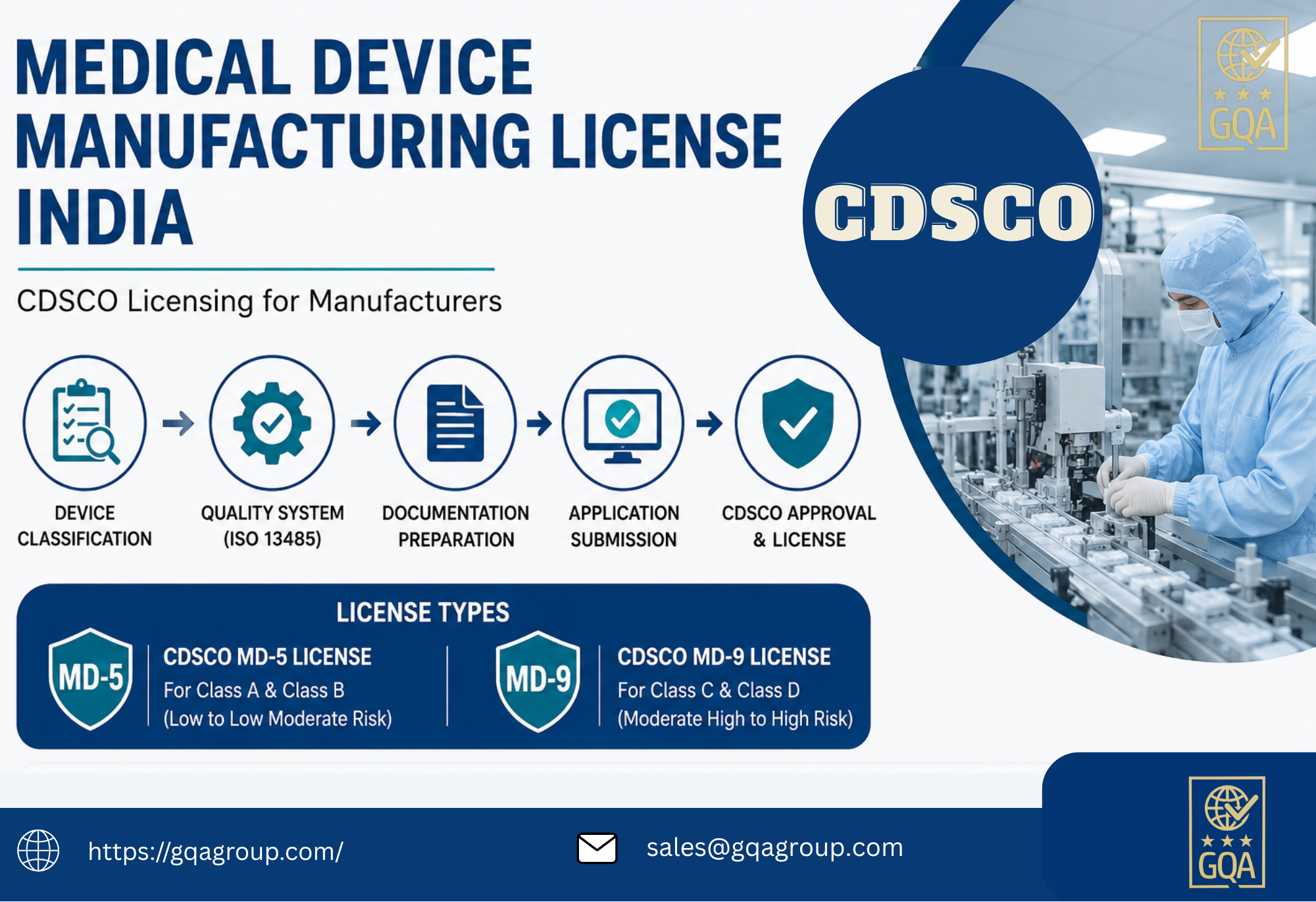
The Indian medical device industry is growing rapidly due to increasing healthcare demand, government support, and expanding global opportunities. Whether you are manufacturing surgical instruments, diagnostic kits, implants, or electronic medical equipment, obtaining a Medical Device Manufacturing License India is a mandatory requirement before legally manufacturing and marketing products in the country.
The licensing and regulatory framework is controlled by the Central Drugs Standard Control Organization under the Medical Devices Rules, 2017. Manufacturers must comply with various regulatory procedures, documentation requirements, and quality standards to receive approval.
In this guide, we will explain the complete CDSCO Manufacturing License Process, important compliance requirements, licensing categories, required documents, and how manufacturers can successfully obtain approval in India.
For professional licensing assistance and regulatory consulting, visit GQA Group.
What is a Medical Device Manufacturing License in India?
A Medical Device License India is an official authorization issued by CDSCO that allows manufacturers to legally produce medical devices in India. The license ensures that the products meet safety, quality, and performance standards before they are introduced into the market.
The licensing requirement applies to manufacturers producing:
- Diagnostic devices
- Surgical instruments
- Medical electronics
- Disposable medical products
- Implants and orthopedic devices
- IVD devices
- Monitoring equipment
Without a valid manufacturing license, companies cannot legally manufacture or distribute regulated medical devices in India.
Understanding the CDSCO Manufacturing License Process
The CDSCO Manufacturing License Process involves multiple stages including classification, documentation preparation, quality management compliance, application submission, and regulatory approval.
The process generally includes:
1. Medical Device Classification
Medical devices are classified into four categories based on risk level:
- Class A - Low Risk
- Class B - Low Moderate Risk
- Class C - Moderate High Risk
- Class D - High Risk
The classification determines the approval authority and regulatory requirements.
2. Quality Management System Compliance
Manufacturers must implement a Quality Management System (QMS) compliant with ISO 13485 standards. CDSCO evaluates manufacturing facilities to ensure proper safety, hygiene, traceability, and product quality practices are followed.
This forms a critical part of CDSCO Compliance Requirements.
3. Preparation of Technical Documentation
The manufacturer must prepare technical files, product specifications, testing data, risk analysis, labeling information, and manufacturing details.
Proper documentation is essential because incomplete applications often lead to delays or rejection.
4. Application Submission Through CDSCO Portal
Applications are submitted online through the CDSCO SUGAM portal. Depending on the risk classification, applications may be reviewed by State Licensing Authorities or CDSCO headquarters.
5. Inspection and Review
Regulatory authorities may conduct site inspections to verify manufacturing infrastructure, equipment, quality controls, and documentation systems.
6. License Approval
After successful evaluation, CDSCO grants the manufacturing license, allowing the company to begin commercial production and distribution.
CDSCO Manufacturing Registration Explained
CDSCO Manufacturing Registration refers to the regulatory registration process required for medical device manufacturers operating in India.
The registration process ensures:
- Product safety
- Manufacturing quality
- Regulatory compliance
- Proper labeling standards
- Traceability of medical devices
Manufacturers must maintain records and comply with post-market surveillance requirements even after obtaining approval.
CDSCO MD-5 License
The CDSCO MD - 5 License is issued for manufacturing Class A and Class B medical devices.
This license is generally granted by the State Licensing Authority after reviewing the application and compliance documents.
The MD-5 license authorizes manufacturers to:
- Manufacture specified medical devices
- Sell products in the Indian market
- Distribute devices through authorized channels
Manufacturers must ensure continued compliance with regulatory requirements to maintain license validity.
CDSCO MD-9 License
The CDSCO MD-9 License applies to manufacturing permissions for Class C and Class D medical devices, which are categorized as higher-risk products.
Since these devices involve greater patient safety risks, CDSCO conducts more detailed scrutiny before approval.
The MD-9 license process may involve:
- Detailed technical evaluation
- Plant inspection
- Performance testing review
- Quality system verification
- Clinical evaluation assessment
Manufacturers dealing with critical medical equipment or implantable products typically require MD-9 approval.
CDSCO Compliance Requirements for Manufacturers
Meeting CDSCO Compliance Requirements is essential for obtaining and maintaining a manufacturing license.
Some major compliance requirements include:
Quality Management System
Manufacturers must establish ISO 13485-compliant systems covering:
- Design control
- Process validation
- Risk management
- Complaint handling
- Corrective and preventive actions
Manufacturing Infrastructure
The facility should have:
- Proper layout and workflow
- Controlled environmental conditions
- Testing and calibration systems
- Trained technical personnel
- Quality control laboratories
Product Labeling Compliance
Labels must include:
- Product name
- Manufacturer details
- Batch number
- Manufacturing date
- Expiry date
- Storage instructions
- Regulatory information
Post-Market Surveillance
Manufacturers are responsible for monitoring product performance and reporting adverse events to CDSCO when necessary.
CDSCO Documentation For Manufacturers
One of the most important aspects of licensing is preparing accurate CDSCO Documentation For Manufacturers.
The required documents may include:
- Company constitution documents
- Manufacturing site details
- Device master file
- Plant master file
- ISO 13485 certificate
- Product specifications
- Test reports
- Risk analysis reports
- Labeling artwork
- Undertaking and declarations
- Authorized signatory details
Accurate documentation significantly improves approval timelines and reduces regulatory objections.
How to Get CDSCO Manufacturing License Successfully
Many businesses ask, How to get CDSCO manufacturing license without unnecessary delays or compliance issues.
Here are some important steps manufacturers should follow:
Understand Product Classification
Correct device classification is the foundation of the licensing process. Incorrect classification may lead to rejection or legal complications.
Implement ISO 13485 Properly
A strong quality management system demonstrates your manufacturing capability and compliance readiness.
Prepare Complete Documentation
Incomplete or inaccurate documentation is one of the biggest reasons for application delays.
Ensure Facility Readiness
Before inspection, ensure your manufacturing site complies with CDSCO standards related to quality, hygiene, documentation, and traceability.
Work with Regulatory Experts
Professional consultants can help manufacturers avoid procedural mistakes and accelerate the approval process.
You can get expert regulatory support from GQA Consultants Pvt. Ltd. for CDSCO licensing, ISO certification, and medical device compliance services.
Importance of CDSCO Licensing for Medical Device Businesses
Obtaining a manufacturing license provides multiple business advantages:
- Legal authorization to manufacture products
- Increased customer trust
- Better market credibility
- Access to hospitals and government tenders
- Improved export opportunities
- Regulatory compliance assurance
As India continues to strengthen medical device regulations, licensed manufacturers gain a strong competitive advantage in both domestic and international markets.
Conclusion
Obtaining a Medical Device Manufacturing License India is a critical step for companies entering the healthcare manufacturing sector. The process involves regulatory classification, quality system implementation, technical documentation, and CDSCO approval procedures.
Whether your business requires a CDSCO MD - 5 License for low-risk devices or a CDSCO MD-9 License for high-risk medical products, understanding the CDSCO Manufacturing License Process is essential for successful approval.
Manufacturers should focus on meeting all CDSCO Compliance Requirements, maintaining proper documentation, and ensuring facility readiness to achieve faster approvals and long-term regulatory compliance.
For professional assistance with CDSCO Manufacturing Registration, licensing, and medical device regulatory consulting, visit GQA Group Official Website.
FAQs
1. What is a Medical Device Manufacturing License in India?
A Medical Device Manufacturing License is an approval issued by CDSCO that allows companies to legally manufacture medical devices in India under Medical Devices Rules, 2017.
2. What is the difference between MD-5 and MD-9 licenses?
The MD-5 license is generally issued for Class A and Class B medical devices, while the MD-9 license applies to higher-risk Class C and Class D medical devices.
3. Is ISO 13485 mandatory for CDSCO manufacturing approval?
Yes, ISO 13485 compliance is an important requirement for demonstrating quality management system implementation during the CDSCO approval process.
4. How long does the CDSCO Manufacturing License Process take?
The approval timeline depends on device classification, documentation quality, and inspection requirements. Proper documentation and compliance can help reduce delays.
5. Can foreign companies apply for CDSCO manufacturing registration in India?
Yes, foreign companies can establish manufacturing operations in India and apply for CDSCO approvals through authorized legal entities and regulatory procedures.