

In today’s competitive market, quality and safety are no longer optional they are essential. This is especially true in the furniture industry, where durability, material safety, and performance directly impact customer trust.
For manufacturers and importers, BIS certification for furniture in India has become a key compliance requirement to legally sell products and build a credible brand.
If you are a manufacturer, importer, or business owner, this complete guide will help you understand the process, cost, requirements, and benefits in a simple and practical way.
What is BIS Certification for Furniture?
The Bureau of Indian Standards (BIS) is the national authority responsible for ensuring product quality and safety in India.
BIS certification for furniture ensures that products meet specific Indian Standards (IS codes) related to strength, durability, and safety.
Furniture products such as:
- Chairs
- Tables
- Office furniture
- Storage units
- Modular furniture
may require mandatory BIS certification depending on government regulations.
Once certified, manufacturers can use the ISI mark, which proves that the product meets national quality standards.
Why BIS Certification for Furniture in India is Important
1. Legal Compliance
Many furniture categories fall under mandatory compliance. Selling non-certified products can lead to penalties, product bans, or legal action.
2. Builds Customer Trust
Customers prefer products with BIS certification because they are tested for safety and performance.
3. Helps in Business Growth
Certification allows you to:
- Participate in government tenders
- Work with large retailers
- Expand into institutional markets
4. Improves Brand Reputation
BIS-certified products stand out in the market and build long-term credibility.
BIS Certification Process for Furniture
Understanding the BIS certification process for furniture helps avoid delays and rejections.
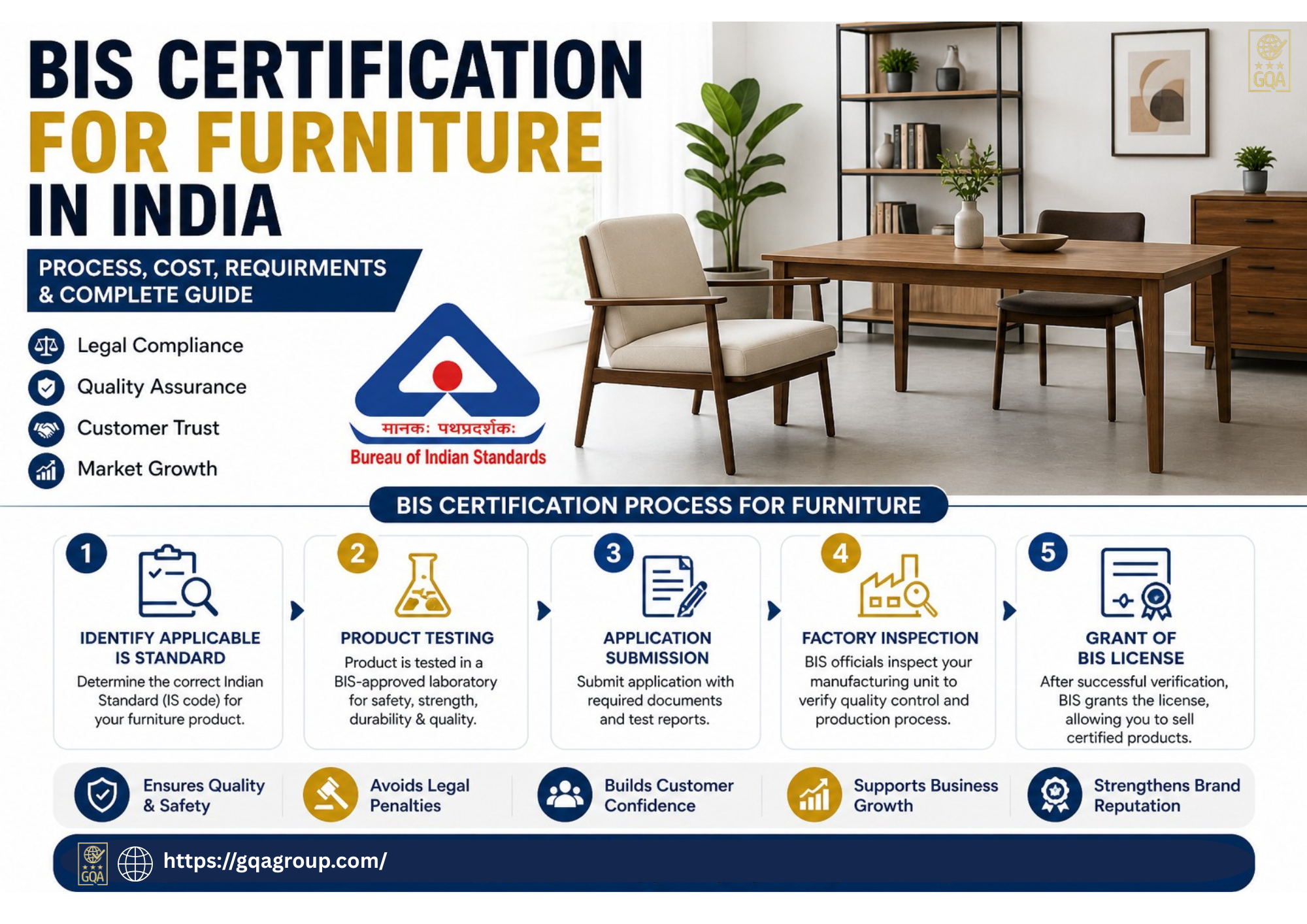
Step 1: Identify Applicable IS Standard
Each product must comply with a specific Indian Standard (IS code). Choosing the correct standard is the first step.
Step 2: Product Testing
The product is tested in a BIS-approved laboratory for:
- Strength and load capacity
- Durability
- Stability
- Material quality
Step 3: Application Submission
Submit your application with required documents:
- Business registration proof
- Product details
- Manufacturing process
- Test reports
Step 4: Factory Inspection
BIS officials may inspect your manufacturing unit to verify quality control and production systems.
Step 5: Grant of BIS License
After successful verification, BIS issues the certification, allowing you to use the ISI mark.
BIS Registration for Furniture
Many people think BIS certification and BIS registration are the same, but they are slightly different. BIS registration is used in some special or simpler cases where manufacturers only need to register their product with the Bureau of Indian Standards before selling. However, BIS registration is not applicable to all furniture products .In most cases, manufacturers are required to go for full BIS certification. Certification includes factory inspection along with product testing.Choosing the correct scheme is important to avoid legal issues and delays
However:
- It is not applicable to all furniture products
- Most manufacturers must go for full BIS certification
- Certification includes both testing and factory inspection
Choosing the correct scheme is very important to avoid delays and legal issues.
BIS Certification Cost for Furniture
The BIS certification cost for furniture depends on multiple factors:
1. Testing Fees
Charges vary based on product type and testing requirements.
2. Application Fees
Standard fees charged by BIS for processing.
3. Inspection Charges
Applicable if factory inspection is required.
4. Annual License Fees
Paid to maintain certification validity.
5. Consultancy Charges
If you hire experts, their service fees are included.
Overall, the cost may range from moderate to high, but it is a valuable investment for long-term business growth.
Common Challenges in BIS Certification
Many manufacturers face issues such as:
- Difficulty in selecting the correct IS standard
- Delays in testing and approvals
- Errors in documentation
- Non-compliance during inspection
- Frequent regulatory updates
In real scenarios, documentation mistakes are one of the biggest reasons for delays.
How Professional Support Can Help
Getting BIS certification can be time-consuming without proper guidance. A professional consultancy can help you:
- Identify the correct standard quickly
- Prepare accurate documentation
- Coordinate with testing labs
- Ensure inspection readiness
- Reduce approval time
Want expert advice? Go here: https://gqagroup.com/
Final Thoughts
The furniture industry in India is growing rapidly due to increasing demand and evolving consumer preferences.
In this competitive environment, BIS certification for furniture in India is not just a legal requirement it is a strategic advantage.
It ensures product quality, builds customer trust, and opens new business opportunities.
Whether you are a small manufacturer or an established brand, investing in BIS certification will strengthen your position in the market.
Frequently Asked Questions (FAQs)
1. Is BIS certification mandatory for furniture in India?
No, it is mandatory only for certain notified categories. However, voluntary certification is highly recommended.
2. How long does the BIS certification process take?
It usually takes 4 to 8 weeks, depending on testing and inspection.
3. What documents are required?
- Business registration
- Product details
- Test reports
- Manufacturing process details
4. What is the cost of BIS certification for furniture?
The cost depends on testing, inspection, and application fees.
5. Can importers apply for BIS certification?
Yes, importers can apply under specific BIS schemes, provided compliance is maintained.